
Physical AI Is Here: What Nvidia’s Robots Teach Marketers About the Next Wave of Automation
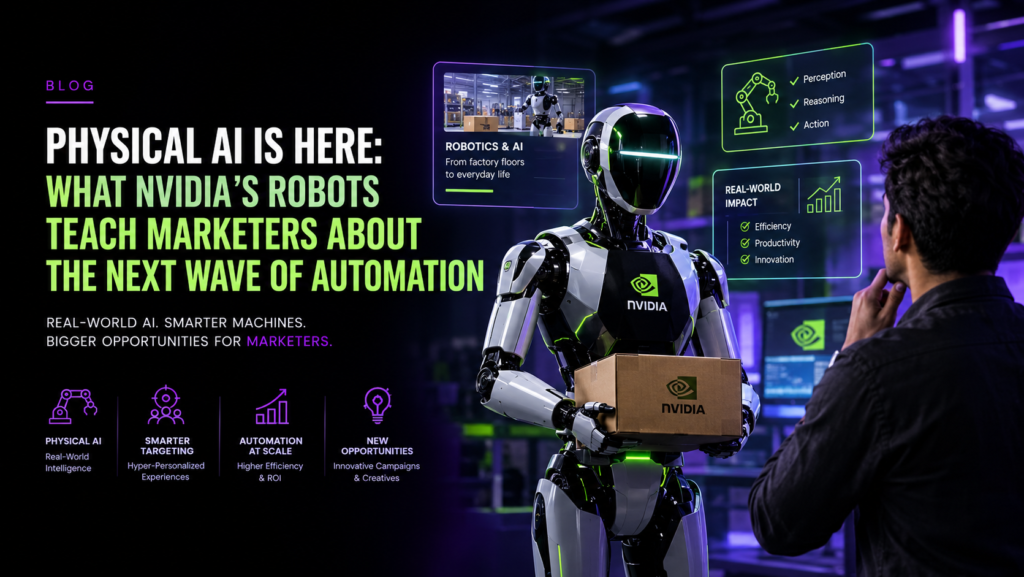
For the past few years, “AI” has mostly meant software: chatbots, image generators, and tools that write ad copy. That’s changing. Nvidia has been pushing hard into what it calls physical AI, where intelligence leaves the screen and acts in the real world through robots.
You might wonder what a humanoid robot has to do with your email funnel or content calendar. Quite a lot. Nvidia’s robotics strategy previews where marketing automation is heading, and the lessons apply right now.
What Nvidia Actually Announced
Nvidia’s robotics push has a few main pieces. Project GR00T is a general-purpose foundation model meant to help robots understand natural language and learn skills by observing human actions. Jetson Thor is the hardware side, a $3,499 developer kit built on Blackwell chips that works as a robot’s “brain,” running several AI models at once without round trips to the cloud. techloyFortune
The crowd favorite was “Blue,” a Star Wars-inspired droid developed with Disney Research and Google DeepMind that walked onto the GTC 2025 stage and interacted with Jensen Huang in real time. It was a technical demo, but it also worked as a story people wanted to share. outlookbusiness
Both sides of that announcement, the technology and the storytelling, hold lessons for marketers.
Lesson 1: Automation Is Moving From “Generate” to “Act”
Most marketing AI today generates things: a subject line, a caption, a blog draft. A human still has to take that output and do something with it.
Physical AI is built around agents that perceive, decide, and act. Marketing is heading the same way. The next generation of tools won’t only suggest a budget shift. They’ll monitor performance, adjust bids, rotate creative, and trigger follow-ups within boundaries you set.
What to do now: Map your workflows and separate tasks that need creativity from tasks that are just repetitive execution. The execution layer is where autonomous systems will land first, so start documenting the rules and goals they’ll need.
Lesson 2: Simulate Before You Spend
Nvidia’s approach to training robots is revealing. Rather than letting a robot learn by failing in the real world, they train it in simulation. At the GTC keynote, Huang described that approach with “This is how we are going to train robots,” as he pointed to what the audience had assumed was real footage but was actually a simulation. Nvidia’s Cosmos models go further by generating hyper-realistic synthetic data to train next-generation robots. outlookbusinesstechloy
Marketers have an equivalent opportunity. Instead of burning budget on live A/B tests that take weeks, you can use AI to:
- Pressure-test messaging against synthetic audience personas
- Predict which creative concepts are likely to resonate before launch
- Model how a campaign might perform across segments
Simulation won’t replace real-world testing, since synthetic audiences are only as good as the data behind them. But it can narrow 20 ideas down to three, so your live budget goes to the strongest candidates.
Lesson 3: Intelligence Is Moving to the Edge
Jetson Thor’s headline feature is that the thinking happens on the machine itself. It’s designed to bring AI decision-making out of distant data centers and onto factory floors, warehouses, hospitals, and farms. Less latency means faster, more responsive action. Fortune
The marketing parallel is real-time personalization. Customers expect experiences that adapt instantly: product recommendations that change mid-session, offers that reflect what someone is doing right now, support that doesn’t make them wait. Batch processing and next-day reports can’t deliver that.
What to do now: Audit your latency. How long does it take from a customer action to a personalized response? If the answer is “hours” or “the next email send,” that’s your gap.
Lesson 3.5: Robots Will Change Customer Experience, Not Just Factories
It’s tempting to treat humanoid robots as a manufacturing story, and early deployments are industrial. Boston Dynamics’ Atlas, for example, was slated for Hyundai’s manufacturing plant, powered by Nvidia’s Isaac GR00T N1 platform. But Nvidia has also pitched applications in warehouses, healthcare, and logistics. techloy
For e-commerce and retail brands, that means the physical side of the customer journey, such as fulfillment speed, in-store assistance, and delivery, will become more automated and more data-rich. Marketers who understand those touchpoints will be able to tell better stories about speed, reliability, and service.
Lesson 4: Great Technology Still Needs a Great Story
Here’s the part that’s easy to miss. Nvidia’s chips are complex. Foundation models for robots are hard to explain. Yet the moment that spread furthest was a small, charming droid walking across a stage.
That’s smart marketing. Blue made an abstract capability tangible and emotional. People who couldn’t explain what a foundation model is could still describe the robot and share the clip.
If your product is complex, your job is to find your “Blue”: a single demonstration, customer story, or visual that makes the value obvious in seconds. Skip the feature list and show one memorable moment.
Lesson 5: Prepare for Natural-Language Everything
Because GR00T is designed to follow natural-language instructions, people can direct robots by describing what they want. This is already happening in marketing software, where you can ask a tool in plain English to “show me which campaigns underperformed last quarter and why.”
Two implications follow:
- Search behavior will shift. As people get used to conversational interfaces, queries get longer and more specific. Your content should answer real questions in clear, natural language.
- Your brand voice will need to work across interfaces. Customers may encounter your brand through a chatbot, a voice assistant, or eventually a physical device. Consistency matters more when you don’t control the screen.
A Practical Starting Checklist
You don’t need a robot to act on any of this. Here’s where to start:
- Document your repeatable workflows so they can be automated safely.
- Experiment with simulation-style testing using AI audience modeling before live campaigns.
- Tighten your real-time data loop between customer behavior and your response.
- Find your “Blue moment”, the one vivid way to demonstrate your value.
- Write for conversation, not just keywords.
- Keep a human in the loop for brand judgment, ethics, and strategy.
The Bottom Line
Physical AI is still early. Most of what Nvidia has shown is developer platforms, pilots, and stage demos rather than robots in every warehouse. But the direction is clear: AI is moving from producing content to taking action, and from the cloud to the real world.
Marketers who treat this as a distant sci-fi story will be caught off guard. Those who treat it as a preview, learning to automate execution, test through simulation, personalize in real time, and tell memorable stories, will be ready when the next wave of automation reaches their desks.
The robots are coming. The smartest move is to get your strategy ready first.